SwarmGesture
02 / 10CRAZYFLIE / AI PROJECT
One hand.
Nineteen moving points.
Ongoing project
From a hand gesture
to a moving formation.
SwarmGesture explores how a webcam and a small set of hand gestures can become an interface for drone choreography.
The project began with the idea of controlling a few Crazyflie drones without a conventional controller. It has developed into a nineteen-drone simulation preview with continuous formations, color patterns, and transitions between shapes.
This is an ongoing master’s AI project. The current focus is the connection between gesture recognition and simulated motion; real-world flight remains a separate validation step.
Recognise the gesture.
Wait for a clear intention.
MediaPipe detects 21 hand landmarks from the webcam. A shared feature extractor turns those points into 63 normalised coordinates, and a trained support vector machine classifies six gestures: fist, OK, one finger, open palm, peace, and three fingers.
The project’s AI work is in collecting labelled landmark samples, training and evaluating the gesture classifier, and connecting predictions to motion. MediaPipe provides the hand detector.
A gesture gate requires stable input and suppresses repeated triggers before sending labels over UDP from the Windows application to the ROS 2 system in Ubuntu through WSL. Takeoff requires manual arming; an open palm requests a return to the grid followed by landing.
Shapes that keep moving.
The current ideal-motion preview includes a pulsing heart, a travelling sine wave, a rotating spiral, a full-to-half moon outline, and a moving 3D helix. Peace, three fingers, and OK select the heart, wave, and spiral; the newer moon and helix are available through keyboard controls and the demo sequence.
Motion models define position, velocity, and acceleration independently of ROS. Shared trajectory code connects formations with smooth transitions, while RViz colors follow the formation’s actual pose.
Transition checks evaluate planned point trajectories for separation and altitude. These checks apply to the ideal preview and do not establish rotor clearance or account for physical tracking errors.
A promising first result.
More testing ahead.
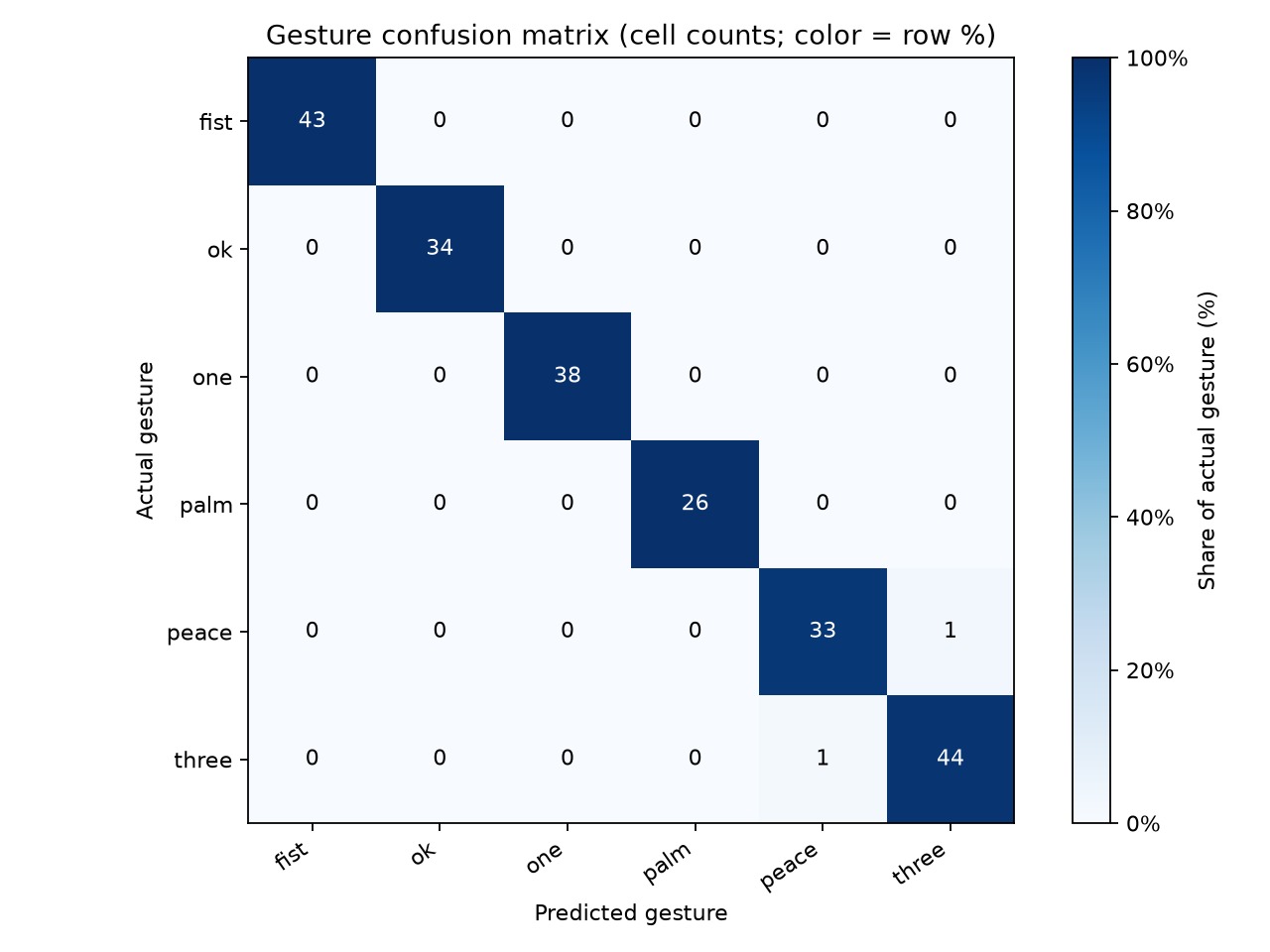
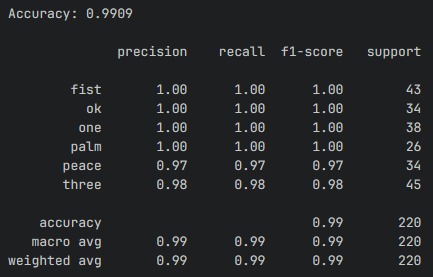
The supplied evaluation captures show 218 correct predictions across 220 samples, or approximately 99.09% accuracy. Four classes have no errors in this run; peace and three fingers are confused once in each direction.
This is an early classifier result. The images do not establish whether test participants or recording sessions were independent of training. Broader testing across people, lighting, and camera angles is needed before claiming general performance. This result also does not measure camera-to-command latency or flight success.
Working toward
the physical swarm.
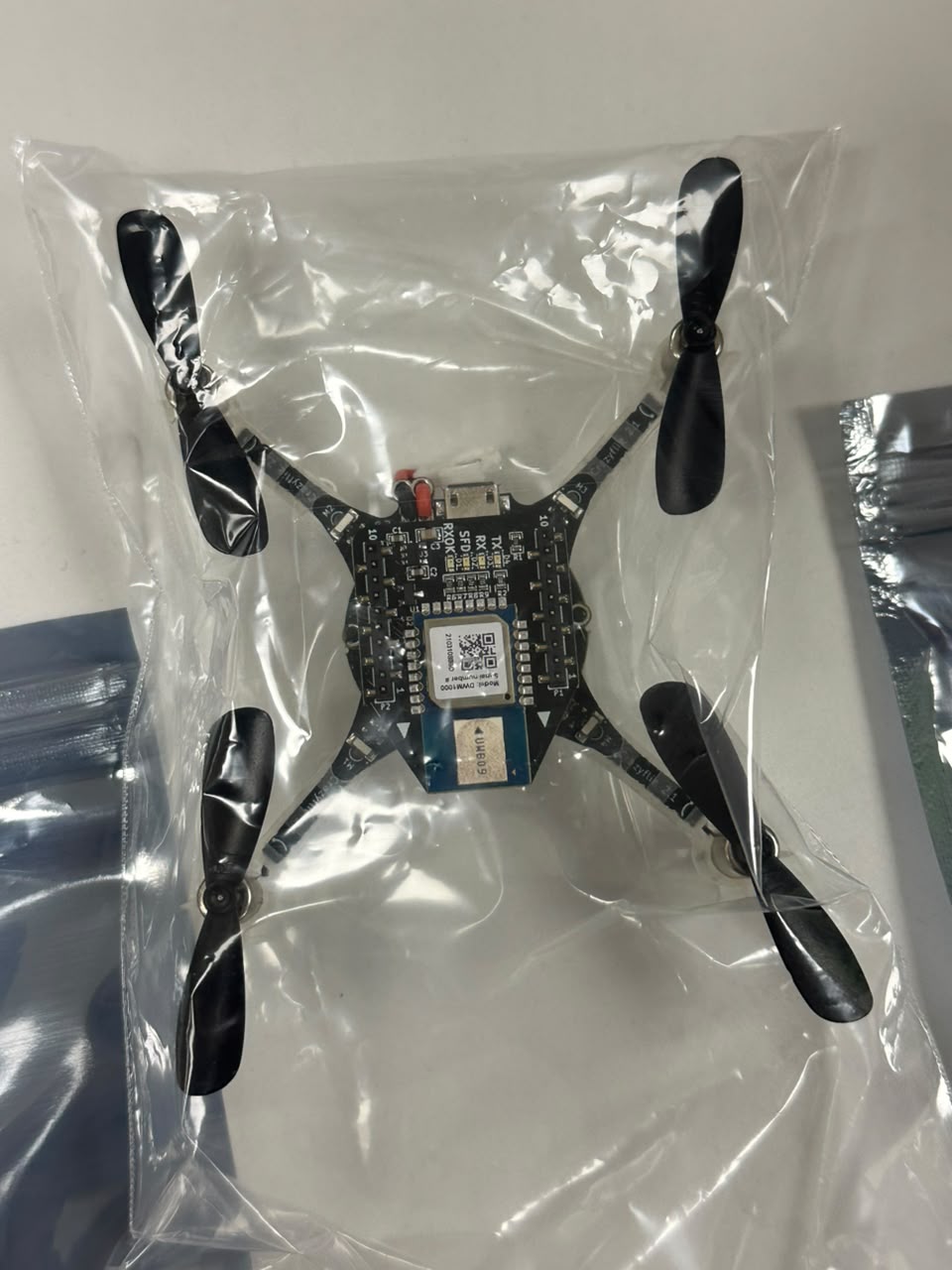
The team visited the drone lab and 3D printed propeller protectors during the initial preparation. The hardware photo shows a Crazyflie quadrotor with an attached positioning deck, still in its packaging.
Physical flight has not been validated. The next work includes broader recognition evaluation and testing the assumptions behind simulated motion against a suitable tracking setup, independent stop controls, and real hardware constraints.
The simulation is the current demonstration. Hardware trials and further interaction experiments remain part of the ongoing project.